Showing posts with label government. Show all posts

Thursday, November 12, 2015

The Enduring Appeal of Abraham Lincoln

The vast amount of literature on Abraham Lincoln (1809–65) is almost unmatched in the English language, behind only that on Jesus and William Shakespeare. Interest in the 16th president of the United States has never abated, but the bicentennial of Lincoln’s birth (2009) along with the sesquicentennials of the Civil War (2011) and Lincoln’s death (2015) have spurred even more interest in his character and the consequences of his presidency.
~Randall M. Miller, "Lincoln, 150 Years On"

There's still time this year to observe the sesquicentennial of the death of Abraham Lincoln, the 16th President of the United States. There is indeed a wealth of material to delve into - besides the non-fiction list we've assembled below, there have been two recent related feature films, Lincoln and The Conspirator, there's a book and a movie about Abraham Lincoln, Vampire Hunter, and Jennifer Chiaverini, best known for her quilting novels, has been writing loosely related historical fiction set in the Civil War period which directly references the Lincoln family, most notably Mrs. Lincoln's Dressmaker. Our society's fascination with Lincoln extends to our presidents - earlier this year, The New York Times published an article called "Abraham Lincoln, the One President All of Them Want to Be More Like". His funeral train, his hat, his poetry - everything has been discussed, it seems.


The Gettysburg Gospel: The Lincoln Speech That Nobody Knows by Gabor Boritt 

Lincoln's Gamble: The Tumultuous Six Months That Gave America the Emancipation Proclamation and Changed the Course of the Civil War by Todd Brewster


Writing the Gettysburg Address by Martin P. Johnson


Mr. Lincoln Goes to War by William Marvel


DVDs


Looking at Lincoln (J) 


For more new items in the library catalog, try a subject search of "Abraham Lincoln" sorted by date. 


Links
This useful resource offers documents, articles, images, biographical videos featuring major Lincoln scholars and interactive resources on the president’s Illinois years.

Cartoons, biographies, articles, book excerpts, maps, quizzes, bio-sketches of Lincoln-era figures and his life.

App
Available for Google Play and iTunes. For students of all ages, an interactive resource produced in conjunction with the Lincoln Presidential Library Foundation.


Friday, July 11, 2014

Startling Discoveries at Special Collections


The cool thing about working at ABC Library’s Special Collections is making new discoveries every week. The humbling thing about working at Special Collections is learning how much more there is to learn! Every day, Special Collections grapples with the fact that living in a city isn’t the same as knowing its history.


Here are a few of our startling discoveries, some culled from our speaker series, some from helping customers make their own startling discoveries. These may be old news to you, but they blew us away:


  • The rail yard buildings are so huge because building and rebuilding steam locomotives meant hoisting the locomotives into the air.
  • The first water treatment plant ran from 8:00 a.m. to 5:00 p.m. daily.
  • Albuquerque’s first street lights were in series, like old fashioned strings of Christmas lights. If one light went out, the whole string went out.
  • Albuquerque was the first community in the United States to hire female streetcar conductors, who were referred to as motorettes.
  • Private rooms in tuberculosis sanatoriums were furnished with ash trays.
  • The Villa de Alburquerque (Old Town) didn't become part of the City of Albuquerque (New Town) until 1949.
  • The planning department changed 300 street names on July 1, 1952.
  • Albuquerque banned discrimination in public places in 1952, but didn't pass a fair housing ordinance until 1963.
  • For the 1956 celebration of Albuquerque’s 250th Anniversary, the City Commission ordered the men of Albuquerque to start growing beards and the women to stop wearing cosmetics.


We’re confident that we have much more to learn, and we invite you to join us! Our speaker series continues on Saturday, July 12th at 10:30 a.m. Come share the startling discoveries as retired Assistant Chief Herman Bishop tells the story of how Albuquerque’s Fire Department moved from the era of the horse drawn fire wagon to age of the hook and ladder.

Tuesday, July 31, 2012

Election Year Reads

Here are a few timely new reads for this election year:


Selecting a President by Eleanor Clift & Matthew Spieler

"Selecting a President explains the nuts and bolts of our presidential electoral system while drawing on rich historical anecdotes from past campaigns. Among the world's many democracies, U.S. presidential elections are unique, where presidential contenders embark on a grueling, spectacular two-year journey that begins in Iowa and New Hampshire, and ends at 1600 Pennsylvania Avenue. Modern presidential campaigns are a marked departure from the process envisioned by America's founders. Yet while they've evolved, many of the basic structures of our original electoral system remain in place--even as presidential elections have moved into the modern era with tools like Twitter and Facebook at their disposal--they must still compete in an election governed by rules and mechanisms conceived in the late eighteenth century. In this book, Clift and Spieler demonstrate that presidential campaigns are exciting, hugely important, disillusioning at times but also inspiring."-- Provided by publisher.


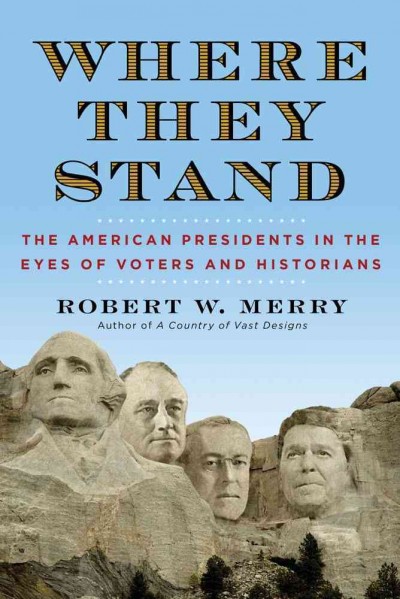
Where They Stand: The American Presidents in the Eyes of Voters and Historians by Robert W. Merry

"Merry examines how and why presidents succeed and fail by recounting the judgments of historians and comparing them to how the voters saw things." -- Provided by publisher.


Almost President: The Men who Lost the Race But Changed the Nation by Scott Farris

"Profiles 12 men who have run for the presidency and lost, but who, even in defeat, have had a greater impact on American history than many of those who have served as president." -- Provided by publisher.


The Candidate: What it Takes to Win, and Hold, the White House by Samuel L. Popkin

"Based on detailed analyses of the winners--and losers--of the last 60 years of presidential campaigns, Popkin explains how challengers get to the White House, how incumbents stay there for a second term, and how successors hold power for their party. He looks in particular at three campaigns--George H.W. Bush's muddled campaign for reelection in 1992, Al Gore's flawed campaign for the presidency in 2000, and Hillary Clinton's mismanaged effort to win the nomination in 2008--and uncovers the lessons that Ronald Reagan can teach future candidates about teamwork. Throughout, Popkin illuminates the intricacies of presidential campaigns--the small details and the big picture, the surprising mistakes and the predictable miscues--in a riveting account of what goes on inside a campaign and what makes one succeed while another fails." - Amazon.com


The Presidents Club: Inside the World's Most Exclusive Fraternity by Nancy Gibbs and Michael Duffy

"Examines presidential power within the context of U.S. history and the ongoing relationships presidents and ex- presidents formed with one another." - Provided by publisher


These last ones are a bit older, but might still be on target today:

1920: The Year of the Six Presidents by David Pietrusza

"The presidential election of 1920 was among history’s most dramatic. Six once-and-future presidents-Wilson, Harding, Coolidge, Hoover, and Teddy and Franklin Roosevelt-jockeyed for the White House. With voters choosing between Wilson’s League of Nations and Harding’s front-porch isolationism, the 1920 election shaped modern America. Women won the vote. Republicans outspent Democrats by 4 to 1, as voters witnessed the first extensive newsreel coverage, modern campaign advertising, and results broadcast on radio. America had become an urban nation: Automobiles, mass production, chain stores, and easy credit transformed the economy. 1920 paints a vivid portrait of America, beset by the Red Scare, jailed dissidents, Prohibition, smoke-filled rooms, bomb-throwing terrorists, and the Klan, gingerly crossing modernity’s threshold." - Amazon.com


Deciding the Next Decider: The 2008 Presidential Race in Rhyme by Calvin Trillin

"Deciding the Next Decider is an ongoing campaign narrative in verse interrupted regularly by other poems, such as a country tune about John Edwards called “Yes, I Know He’s a Mill Worker’s Son, But There’s Hollywood in That Hair” and a Sarah Palin song about her foreign policy credentials: “On a Clear Day, I See Vladivostok.” It covers Mitt Romney’s transformation (“Mitt Romney’s saying now he should have known / A stem cell’s just a human, not quite grown”), the speculation about whether Al Gore was trimming down to run (“Presumably, they looked for photo ops / To see what Gore was stuffing in his chops”), the slow-motion implosion of Hillary Clinton’s drive to the White House (“Some pundits wrote that Hil’s campaign might fare / A little better if Bill wasn’t there”), and the differing responses of Barack Obama and John McCain to the financial crisis (“Though coolness has its limitations, it’ll / Prevent comparisons with Chicken Little”)."  - Amazon.com


On the Campaign Trail: The Long Road of Presidential Politics, 1860-2004 edited by Douglas E. Schoen

"An elated, victorious Truman brandishes a newspaper with the headline 'Dewey Defeats Truman'. Theodore Roosevelt galvanizes the crowd with a fiery stump speech. Richard Nixon wipes away sweat during his debate with a poised JFK. Against the backdrop of a towering flag, Reagan captivates crowds with his promise of a stronger, prouder America. Bill Clinton weaves a spell with his saxophone. Throughout American history, few events have commanded the undivided attention of the public the way presidential campaigns have. Now the enduring moments of inspiration, the humiliating gaffes, and the heartbreaking losses of these campaigns are captured in a historic collection of photographs from America's greatest photojournalists. From the divisive election of Abraham Lincoln to the opening salvos of the 2004 campaign, America's presidents -- and pretenders to the office -- come to life in these pages. These men embody not only the drama of their times, but also the great arc of American history. They are captured here in pivotal and telling campaign moments: on the stage and behind the scenes, on whistle-stop tours, at high-voltage conventions, and in head-to-head debates. Accompanied by political adviser Douglas E. Schoen's trenchant essays, the striking photographs in On the Campaign Trail offer a unique view of the moments that have united and divided us during the race for the presidency. A fascinating journey in words and images, this landmark collection brings home the drama, fanfare, and power of America's great national contest." - Amazon.com


Looking Forward to It, or, How I Learned to Stop Worrying and Love the American Electoral Process by Stephen Elliott

"Stephen Elliott does not know what to think of American voters, this year's desperate and heated run for presidency, or the legitimacy of the political system. He doesn't know whether to love John Kerry or try to love Howard Dean or try, simply, to get excited about Politics. But what he does know is that most Americans are as confused, taxed and broken-hearted as he is. Looking Forward To It is the chronicle of one ordinary fellow's skeptical -- and hilarious -- journey through the election process. It is on the campaign trail that he will meet washed-out campaign managers, idealistic publicists, corrupt journalists, world-weary auditorium janitors, recovering drug addicts, and, of course, politicians. His report documents a journey into the center of 'the thing', our country, where Americans high and low come together to participate in the most profound gesture of democracy: the election." -- Amazon.com


Find more interesting election-year reads using a subject search of "Presidents - United States - Elections"!

Thursday, January 19, 2012

Get Ready Genealogists!

1940 CENSUS BEING RELEASED IN APRIL!


April 2, 2012 is a date many genealogists are eagerly awaiting.  This is the day that the 1940 Census will be released to the public!  For many of us, including myself, this is exciting stuff.  I will now be able to further construct my great-grandfather's timeline and where he was living when the enumerators came knocking at his door.

Census records have been recorded in America from 1790 to the present.  From the years 1790-1850 not much information was given, only head of household, how many family members and what age groups they were, such as how many males under 5 or how many females over 15.  Starting in 1850 more questions began to appear, such as the place of birth of each person, either a county was listed or a state, if a person married within the year, the age of each family member, the value of any property and the occupation of the residents.  In 1870 and 1880 began to list the month each person was born, naturalization information, whether the parents were born in a place other than the US and most often would list the place of birth.  The 1890 census met with an unfortunate fate.  Most of the records were destroyed in a fire and only a few fragments were recovered.

Beginning in 1900 even more information was obtained such as the number of years individuals had been married, how many children a woman had and how many lived, the year of immigration to the US, whether their status was "AI" for Alien, "PA" for first papers, or "NA" for naturalized, if they owned or rented their home and if that home still had a mortgage or was owned free and clear.  The 1910,1920 and 1930 census had basically the same information as the 1900, with a few exceptions.  The 1910 census listed if a person was a survivor of the Civil War and was indicated by a "UA" or "UN" for Union Army or Navy, or a "CA" or "CN" for Confederate Army or Navy. By the 1930 census any Civil War participants still living were listed with "CW"  Also, on the 1910 census there are several numbers that scribbled over information in columns 30-32 and is statistical data only that was used by the Census department and not related to the person listed.   The 1920 census listed the year the individual was naturalized and the 1930 census listed if a man had military service in other wars such as "SP" for the Spanish-American War, "Phil" for Phillipine Insurrection", "Box" for the Boxer Rebellion, "Mex" for Mexican Expedition and "WW" for World War I.  This I found quite interesting to know as I never knew what those initials meant and now can go back to see if any relatives served in any of those conflicts.

There are some websites where census indexes and records can be searched for free, but not all the years are available.  A couple of decent ones are usgwarchives.org/census, which can be searched by states if you know where an ancestor may have lived and http://www.censusfinder.com/.  Most of the Census Finder website is index records only, but I have found where an ancestor was listed in the index which told me that a record was done, so that was a good aid to use.

In the 1940 census which will be released at 9:00 AM on April 2, in additon to the standard questions, there are several new fields that were added.  The enumerators were told to put a "circled X" after the person's name answering the questions.  Some of the questions asked were if the person ever worked for the CCC, WPA or NYA during the week of March 24-30, 1940 and the income for the previous year ending December 31, 1939.  With this census there is a supplemental schedule to have two names for each page, the place of birth of the person's father and mother, the person's usual occupation, about whether all the women in the household have been married or not, if they were married more than once, and the age of first marriage.  It will also have the location, such as street, avenue or road, and house number.  This of course is the first census where the question could be asked if the person had a Social Security number.

The census will be made available to the public for research on April 2nd, but only at a National Archives location and the closest one to Albuquerque is in Denver.  However, the Genealogy section at the Main Library will most likely have the census as soon as it can be transcribed after the release date, whether throught the Ancestry or Heritage Quest database.  Also, Fold3 History and Genealogy Archives may have some older census records, but it is not known at this time if they will have any of the 1940 census.  There should be more information on what the Genealogy section will have at a later date.  There will be no name index available at the National Archives, but Ancestry.com and FamilySearch.org have both stated they will have one as soon as it can be transcribed after the release date.  If you decide to use Ancestry from your home computer there is a monthly fee involved and the basic fee for searching US records is $19.95.