Saturday, March 15, 2014

Judging Books Based on Their Covers Part 3: Same Book, Different Cover

It's not unusual for books to have multiple covers. Often, a hardcover version of a book will have a different cover from the paperback version. Books that are published in more than one country also often have different covers. Updated editions or newer editions of books might also get a new cover treatment. Does this matter when it comes to deciding to read a book based on its cover? It might.


The Disenchantments by Nina LaCour


The image on the left is the cover for the hardback copy of The Disenchantments. The second image, which is from Goodreads, is of the paperback. I don't find either cover to be too appealing, but if I had to read this book based only on its cover, I would read it based on the paperback cover, not hardback cover.


The first image again is for the hardback cover. The second image, which is also from Goodreads, is for the paperback cover. I don't like the hardback cover, but I love the paperback cover.
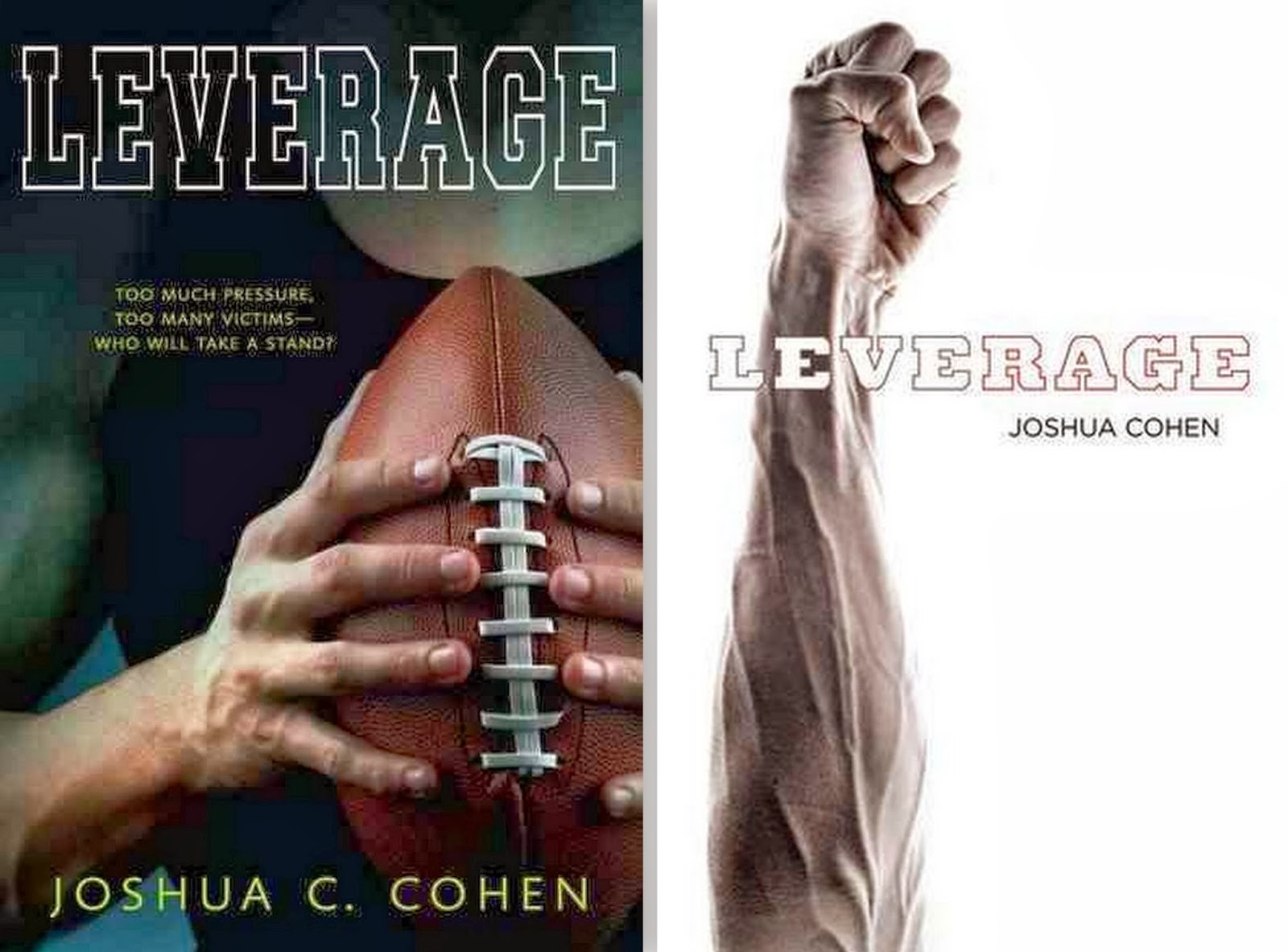


Leverage by Joshua C. Cohen

This time, the first image is for the paperback cover, and the second image is for the hardback cover. Leverage is one of my favorite books, but I don't like either cover. If I had to read it based only on the cover, I'd pick the paperback cover. I don't feel like either cover represents the book as well as they could, but the hardback cover seems less representative of the book to me.


The Shining by Stephen King

Both images for The Shining are from Goodreads. The image on the left is the mass market paperback edition published by Anchor in 2012. The image on the right is the mass market paperback edition published by Signet in 1978. Over the years, The Shining has received multiple cover treatments. Goodreads has a good list of the different editions with the different covers. Based on these two covers though, I would read The Shining because of the cover on the left. It's more intriguing and terrifying than the cover on the right.

Do you read books based on their covers? When it comes to buying books, do you pick which edition to buy based on the cover?

Friday, March 14, 2014

International Pi Day


March 14 (3.14) marks International Pi Day.  A day to celebrate the mathematical constant of the ratio of the circumference of a circle to its diameter.

Pi is approximately 3.14159, but continues indefinitely without repetition or pattern, and is an irrational and transcendental number.  It has been calculated to over a trillion digits past the decimal.

Fun Fact: March 14 is also Einstein's birthday.  Instead of celebrating with the traditional cake, we recommend celebrating with pi(zza) and/or pi(e).

Here's a general rubric for a fruit pie from the Kitchn:

Pie Crust (store bought, homemade, whatever you prefer and time allows)
4-6 cups chopped fruit
1-2 tablespoons cornstarch (or other thickener, i.e. flour, quick cooking tapioca)
1/2 cup brown or white sugar
Lemon zest from 1 lemon and some juice if you like
Pinch of salt
1/2- 2 teaspoons spices (cinnamon, allspice, nutmeg, cloves; whatever fits your fancy)
1 tablespoon butter

Line pie plate with crust.  If you don't have a pie plate, directions are below.

Combine the filling ingredients, except for the butter, and place in crust.  Top with butter.

Top with second crust, a crumble or streusel topping, depending on personal preference.

Bake at 400* for 40 minutes, or until bubbly.  You may want to put aluminum foil around the edge for the first 20 minutes to make sure it doesn't get too brown.

No pie plate modification: You can make this without a pie plate, just call it a "rustic fruit tart".  You'll need only 1 crust.

Roll the crust out on a cookie sheet.

Make the filling, but use 4 cups of fruit instead of 6.  Mound in the middle of the crust.  Fold the edges in and  partially over the fruit.  Top with butter.  Bake at 350* for 40 minutes or until bubbly.

Cool and Enjoy!

Cookbooks featuring pies can be found in the Non-Fiction section under number 641.8.  Books about Pi can be found in Non-Fiction under number 512 for Juvenile and Adult.

Wednesday, March 12, 2014

Shifted Perspectives

Now, adaptation, cross-pollination and flat out stealing are nothing new in the literary world — after all, Madame Bovary was heavily influenced by Don Quixote, Finnegans Wake was inspired by Alice’s Adventures in Wonderland, and Wide Sargasso Sea is a prequel to Jane Eyre. And those are just a few sterling examples — the trend of adaptation and re-adaptation is rampant, and sadly, there are plenty of cheap reincarnations of classic texts that put their inspirations to shame.
~Emily Temple, "10 Contemporary Novels Based on Classic Lit That Are Actually Worth Your Time" 


The publication of Longbourn, the novel by Jo Baker which retells the story of Pride and Prejudice from the point of view of the servants,  got us thinking about other novels that retell a story.  Wide Sargasso Sea retells the story of Jane Eyre from the point of view of the "madwoman in the attic", Bertha Rochester (born Antoinette Cosway). The Mists of Avalon retells the Arthurian legend from the point of view of the female characters, primarily Morgaine (Morgan le Fay), Arthur's half-sister.

In these "shifted perspective" novels, the traditional protagonist is no longer in the limelight, and the story is retold through the eyes of another (many novels are also reinterpreted by changing the time in which the stories happen, but that's the subject of another blog post). We find these revisited stories interesting because, in the right hands, the changed viewpoint takes the reader in new and interesting directions, including calling into question the reliability of the original novel's narrator.

Despite some wrangles with the estates of the authors of the original novels (in the case of Lolita and The Lord of the Rings), we are seeing more and more retold classics with shifted perspectives. Here are some you can find in the library catalog:


Wicked: The Life and Times of the Wicked Witch of the West by Gregory Maguire

Ahab's Wife, or, The Star-Gazer by Sena Jeter Naslund

Finn by Jon Clinch

The Wind Done Gone by Alice Randall

Jack Maggs by Peter Carey

March by Geraldine Brooks

Becky: The Life and Loves of Becky Thatcher by Lenore Hart

Lady Macbeth by Susan Fraser King

The Red Tent by Anita Diamant

Lavinia by Ursula K. Le Guin

The Penelopiad by Margaret Atwood

Monster: A Novel of Frankenstein by Dave Zeltserman

Adèle: Jane Eyre's Hidden Story by Emma Tennant

Rebecca's Tale by Sally Beauman      

Ophelia by Lisa M. Klein [YA]
  

Links

"10 Shifted Perspective Novels I Would Totally Read" 

"Make lit new: Are retold tales a new fad or the latest incarnation of a rich tradition?"  

"Middle-earth according to Mordor"

"Pact Reached on U.S. Edition of  'Lolita' Retelling"


Sunday, March 9, 2014

Book Reviews and Plot Twists: Friends or Foes?

Here at abcreads, we're always on the lookout for new books, and reviews can be helpful and hurtful in the search for our next read. Why? Book spoilers. For those of us who enjoy the element of surprise or like to discover the culprit on our own, plot summaries in reviews sometimes tell us more than we want to know. Recently, the Washington Post's fiction editor, Ron Charles, wrote about the dilemma of how much to reveal when writing a book review (spoiler alert! don't read this if you want to stay in the dark about Boy, Snow, Bird). In it, he contemplates the questions: How much is too much? Does revealing a plot twist enhance or hurt the reader experience?

Plot twists can break our hearts, blow our minds, and cause us to question everything we've read in the last 300 or so pages. All-in-all, they give us the irreplaceable feeling of "what just happened?!" If you enjoy a well-crafted plot twist (and haven't already heard about these endings), here are some of our suggestions:

Gentlemen & Players by Joanne Harris

Shutter Island by Dennis Lehane

And Then There Were None by Agatha Christie (ebook)

Gone Girl by Gillian Flynn (ebook)

Atonement by Ian McEwan (ebook)

The Secret Keeper by Kate Morton

Fight Club by Chuck Palahniuk

Thursday, March 6, 2014

Science Corner: Recommended Reads

Learn from yesterday, live for today, hope for tomorrow. The important thing is to not stop questioning.
 ― Albert Einstein

Somewhere, something incredible is waiting to be known.
― Carl Sagan  


We are just an advanced breed of monkeys on a minor planet of a very average star. But we can understand the Universe. That makes us something very special.
 ― Stephen Hawking 

The fact that we live at the bottom of a deep gravity well, on the surface of a gas covered planet going around a nuclear fireball 90 million miles away and think this to be normal is obviously some indication of how skewed our perspective tends to be.
― Douglas Adams


Here are some of the favorite science reads of library staff.  Feel free to let us know your recommendations in the comments!


Incomplete Nature begins by accepting what other theories try to deny: that, although mental contents do indeed lack these material-energetic properties, they are still entirely products of physical processes and have an unprecedented kind of causal power that is unlike anything that physics and chemistry alone have so far explained. Paradoxically, it is the intrinsic incompleteness of these semiotic and teleological phenomena that is the source of their unique form of physical influence in the world. Incomplete Nature meticulously traces the emergence of this special causal capacity from simple thermodynamics to self-organizing dynamics to living and mental dynamics, and it demonstrates how specific absences (or constraints) play the critical causal role in the organization of physical processes that generate these properties. [from the publisher]


The Higgs boson is one of our era’s most fascinating scientific frontiers and the key to understanding why mass exists. The most recent book on the subject, The God Particle, was a bestseller. Now, Caltech physicist Sean Carroll documents the doorway that is opening—after billions of dollars and the efforts of thousands of researchers at the Large Hadron Collider in Switzerland—into the mind-boggling world of dark matter. The Particle at the End of the Universe has it all: money and politics, jealousy and self-sacrifice, history and cutting-edge physics—all grippingly told by a rising star of science writing. 


A rising star in theoretical physics offers his awesome vision of our universe and beyond, all beginning with a simple question: Why does time move forward?


Love and Math tells the two intertwined stories of mathematics and the adventure of one man in learning it. The result is a story about how he became one of the twenty-first century's leading mathematicians, working on one of the biggest ideas to come out of mathematics in the last 50 years: the Langlands Program. As Frenkel proves, a mathematical formula can be as elegant and beautiful as a painting, a poem, or a piece of music. And the process of creating new mathematics is just that, an artistic pursuit--a deeply personal experience, which requires passion, dedication, and love. In Love and Math, Frenkel shows readers the aesthetic--and the truly powerful--side of mathematics, and enables appreciation of the field even from those who have long been terrified by it.


Book descriptions are taken from the catalog unless otherwise noted.

Tuesday, March 4, 2014

Biography for Book Lovers

For avowed bookworms, the next best thing to a shiny new paperback is a lively conversation with a fellow reader about the books they love -- and hate. The best of both worlds can be found in the reading memoirs we've rounded up here, in which bibliophiles share the books that shaped them.
~Joanna Scutts, "Read Me Like a Book: 7 Must-Read Memoirs for Book Lovers"

Azar Nafisi's Reading Lolita in Tehran is a classic of this genre - a tale that intertwines memoir with a discussion of literature. In Nafisi's cases, this "memoir in books" was a recounting of gatherings with her former students to talk about literature forbidden by a a repressive regime.  These gatherings became "forum[s] to learn to speak freely, not only about literature, but also about the social, political, and cultural realities of living under strict Islamic rule". Not all these memoirs carry such a weighty message - one celebrates father-daughter "reading-out-loud sessions every night before bed"; another is an account of a life of collecting books and setting up bookstores; another is a response to one author's writing crisis; yet another is an account of a quest to read the entire 50-volume set of the Harvard Classics. As Anna Quindlen says in How Reading Changed My Life,  “Books are the plane, and the train, and the road. They are the destination, and the journey. They are home.”

Tolstoy and the Purple Chair: My Year of Magical Reading by Nina Sankovitch

My Reading Life by Pat Conroy

The Novel Cure: From Abandoment to Zestlessness - 751 Books to Cure What Ails You by Ella Berthoud and Susan Elderkin

The Reading Promise: My Father and the Books We Shared by Alice Ozma

Leave Me Alone, I'm Reading: Finding and Losing Myself in Books by Maureen Corrigan

So Many Books, So Little Time: A Year of Passionate Reading by Sara Nelson

Thirteen Ways of Looking at the Novel by Jane Smiley

What Makes This Book So Great: Re-Reading the Classics of Science Fiction and Fantasy by Jo Walton

The Whole Five Feet: What the Great Books Taught Me About Life, Death, and Pretty Much Everything Else by Christopher R. Beha

Books: A Memoir by Larry McMurtry  

Reading Jackie: Her Autobiography in Books by William Kuhn

My Life in Middlemarch by Rebecca Mead

Romance is My Day Job: A Memoir of Finding Love At Last by Patience Bloom

How Literature Saved My Life by by David Shields

Shakespeare Saved My Life: Ten Years in Solitary with the Bard by Laura Bates [eBook]

Judging a Book By Its Lover: A Field Guide to the Hearts and Minds of Readers Everywhere by Lauren Leto

Life Sentences: Literary Judgments and Accounts by William H. Gass

All Roads Lead to Austen: A Yearlong Journey with Jane by Amy Elizabeth Smith     

The Possessed: Adventures with Russian Books and the People Who Read Them by Elif Batuman 

Saturday, March 1, 2014

Judging Books Based on Their Covers Part Two: When the Cover Doesn't Match the Story

Last week, I took a look at different books that have the same covers. This week, I'm taking a look at two book covers that for me, don't match the story because they don't do a good job portraying what the book is about.

First up is Panic by Lauren Oliver.


I like this cover. But when I look at it, it doesn't give me any kind of idea what the book is about. The summary of the book is: "In the poor town of Carp, New York, a group of teens enters a high-stakes game that involves a series of secretive, possibly deadly challenges throughout the summer, with the winner receiving more than $50,000--enough money to start a new life."

For me, the cover doesn't indicate anything about fear--the girl on the cover doesn't look particularly scared, and I would never guess that she's participating in a possibly deadly game.

Next up: Dangerous Girls by Abigail Haas.


This cover doesn't do anything for the book. I talked to a bookseller recently about how bad the cover is, and we wondered why the publisher thought it would appeal to readers. A colleague of mine and I also talked about it, and while I think the cover indicates that the book takes place by a beach, my colleague said the cover makes her think of a desert. To be fair, I've read the book and my colleague hasn't, which is why I look at the sand on the cover and think beach (the book takes place in Aruba). The handcuffs covered in sand and the flower do seem a little strange, and definitely don't convey what the book is really about.

In talking about Dangerous Girls, my colleague and I also looked at the UK and German covers, as well as the paperback cover for the U.S. edition.


The first image is of the UK edition and was found on Goodreads. This cover doesn't describe the book at all. It's a pretty cover; I love the colors. But shards of glass? That has nothing to do with the book.

The second image is of the German edition and was found on the author's Twitter account. Again, it's pretty, and I like how it incorporates the beach but in a creepy way (unlike the cover with the handcuffs in the sand). What I'm not sure about with this cover is the girl--why is her hair covering her face? Does this make her more creepy or less creepy? I feel like it's supposed to be symbolic of something, but I can't quite figure out what.

The third image is of the U.S. paperback edition and was also found on the author's Twitter account. My colleague and I agreed that this was the best cover, as it's more obvious that the book is about a dead girl. My colleague also liked the font and color used for the book's title on this cover. It's girly, but also hints at something a bit more sinister, which is perfect for what this book is about.

Book covers can set the tone and mood for a book is about, and when the cover doesn't do a good job of conveying these things, it might mean it's not doing a good job conveying what a book is actually about.

Like I did with Dangerous Girls, Judging a Book Based on Their Covers Part Three will focus on different covers of the same books.